ImageboxSite LogoLeft ArrowPrevious ItemNext ItemRight ArrowBlog PostEventGrowIgniteLaunchLocationXMenuQuoteSearchGoogle PlusYoutube
New Sun Rising
Menu
Close
  • How We Work
    • Overview
    • Impact Areas
    • Development Phases
  • Capacity Building
    • Nonprofit Resilience Program
    • Sustainable Futures Initiative
    • Learning Resources
  • Accessible Funding
    • Fiscal Sponsorship
    • 250 Tables
    • Community Grantmaking
  • Data + Advocacy
    • Vibrancy Portal
    • Virtual Support Center
    • Community Voice
    • Creative Advocacy
  • Spaces
    • Food + Energy Hub
    • Solar Garden Patio
  • Home
  • Blog
  • Projects We Support
  • About Us
    • Team
    • We Stand Against Racism + Discrimination
    • We Hear You
    • History
    • Jobs + Opportunities
  • Contact
  • Make a Donation
New Sun Rising
  • Home
  • Blog
  • Projects We Support
  • About Us
    • Team
    • We Stand Against Racism + Discrimination
    • We Hear You
    • History
    • Jobs + Opportunities
  • Contact
  • Search
  • Make a Donation
  • How We Work
    • Overview
    • Impact Areas
    • Development Phases
  • Capacity Building
    • Nonprofit Resilience Program
    • Sustainable Futures Initiative
    • Learning Resources
  • Accessible Funding
    • Fiscal Sponsorship
    • 250 Tables
    • Community Grantmaking
  • Data + Advocacy
    • Vibrancy Portal
    • Virtual Support Center
    • Community Voice
    • Creative Advocacy
  • Spaces
    • Food + Energy Hub
    • Solar Garden Patio
The Blog of NSR

Tag: vibrancy portal

Lack of affordable housing, reliable public transit tied to poverty, hunger in Allegheny County
Posted on November 7, 2023 by Alyse Horn

In August, a local nonprofit released a study detailing the rise of corporations and investors buying homes in the city of Pittsburgh, finding that these sales rose 10% over the past decade.

The report, released by the Pittsburgh Community Reinvestment Group (PCRG), said in 2010, corporations or investors purchased 15.5% of the available housing market. In 2021, that rose to nearly 25%.

It also included that “corporate entities paid 70.2% of the average sale price, compared to all purchases in Pittsburgh, and 72.4% of the average sale price in the remaining parts of Allegheny County.” Many of the census tracts with a higher share of corporate sales were reflected in “historically Black and/or Low- and Moderate-Income (LMI) communities.”

According to data collected through New Sun Rising’s Vibrancy Index, 62.7% of Allegheny County residents are homeowners and 13.4% spend more than one third of their total income towards housing and utilities. 
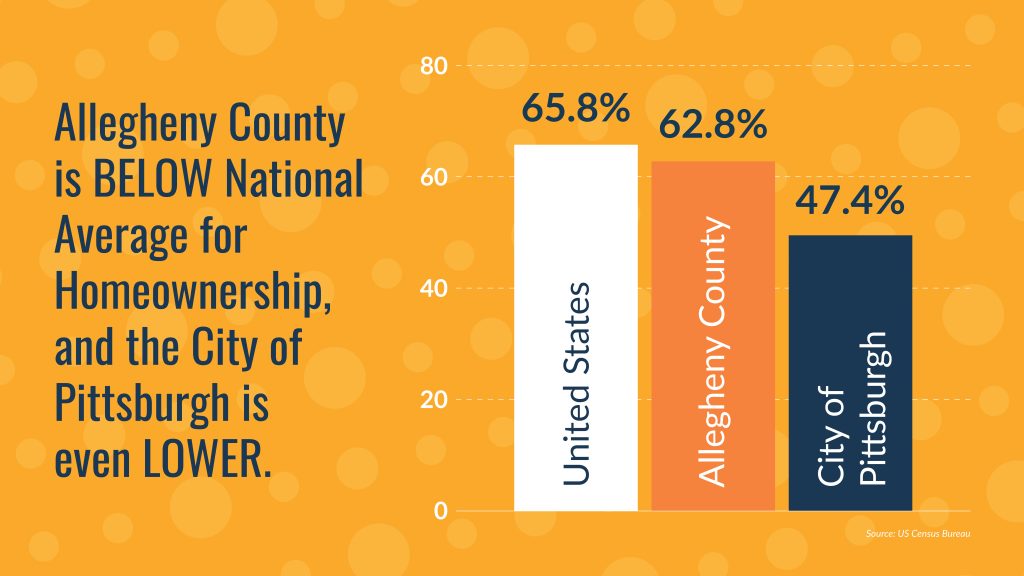
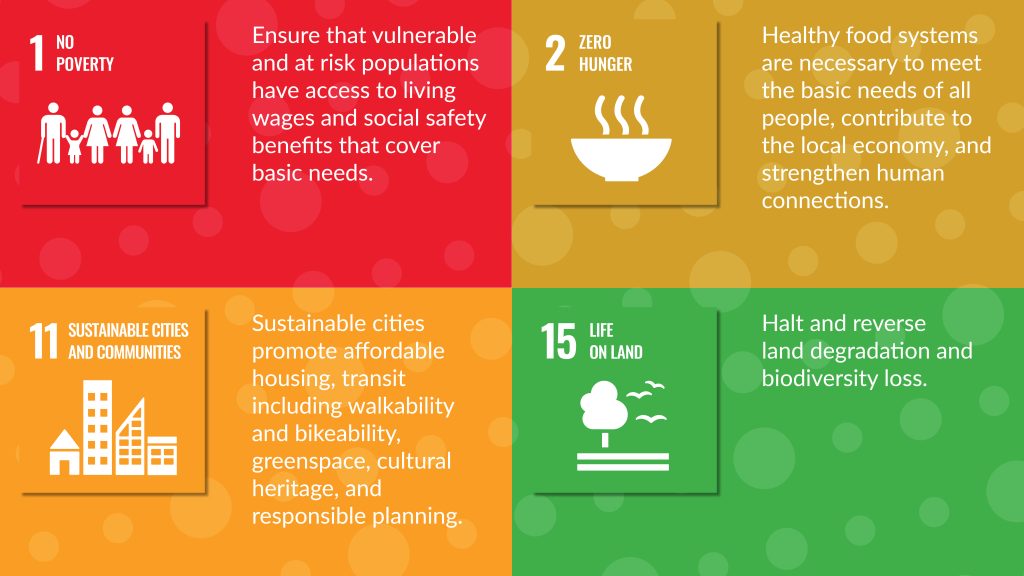
Affordable housing falls under Sustainable Development Goal 11: Sustainable Cities and Communities (SDG 11), as do transit issues such as walkability and bikeability, green space, and responsible planning. 

Focusing on affordable housing in our region, analysis shows that Southwestern PA communities that fall within the lowest 20% for SDG 11 also rank lower for No Poverty (SDG 1), Zero Hunger (SDG 2), and Life on Land (SDG 15). These communities with the lowest sustainable cities index scores have 5.65x the racial and ethnic diversity of those scoring highest.

There are a total of 17 SDG’s, which were created globally as a call to action to raise the quality of life for all people and preserve the future of our planet.
“[Investors] look at where there is economic value and what are the opportunities for development, and we’re forgetting [about the people],” said Becca Simon, former director of programming at Grounded. “There’s not a sense of urgency around the fact that in Allegheny County and in the city of Pittsburgh we’ve seen a major displacement of predominantly Black people in this area.” 

Grounded is based in Bakery Square and aims to improve the social, economic, and environmental health of distressed and transitional communities by building capacity to reclaim vacant and underutilized land.

Furthermore, through an assessment conducted by the City of Pittsburgh from 2015-2019, it was found that low-income renters, Black households, and Black homeownership declined over that five year period. 

In the same vein, the lack of access to reliable public transit weighs more heavily on diverse populations and LMI communities. 

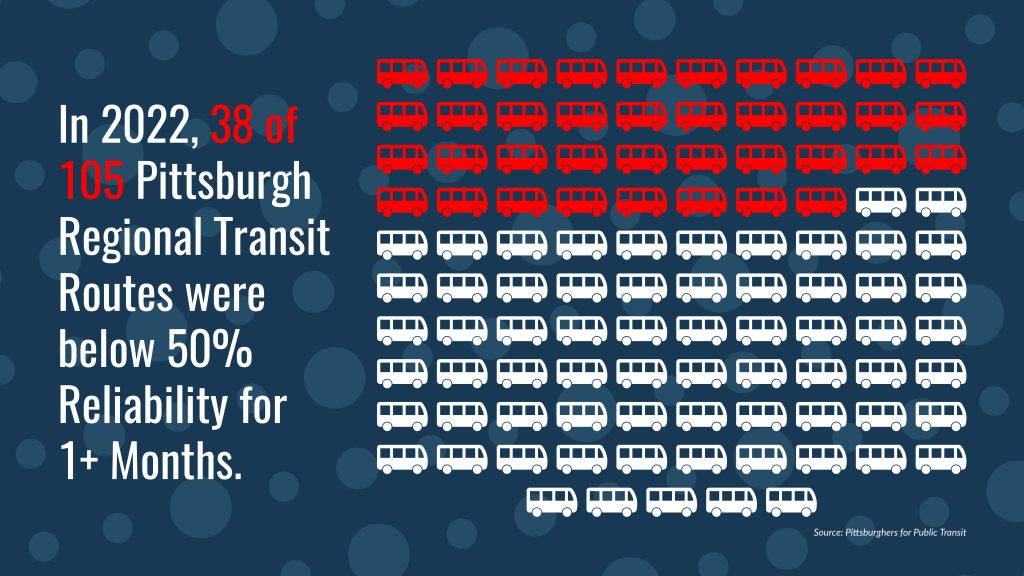
A study done by Pittsburghers for Public Transit (PPT) and Carnegie Mellon University’s Tech4Society found that in 2022, 38 out of 105 Pittsburgh Regional Transit (PRT) routes were below 50% reliability for at least one month. In June 2022 specifically, there was 8% less transit service across Allegheny County compared to October 2019. 
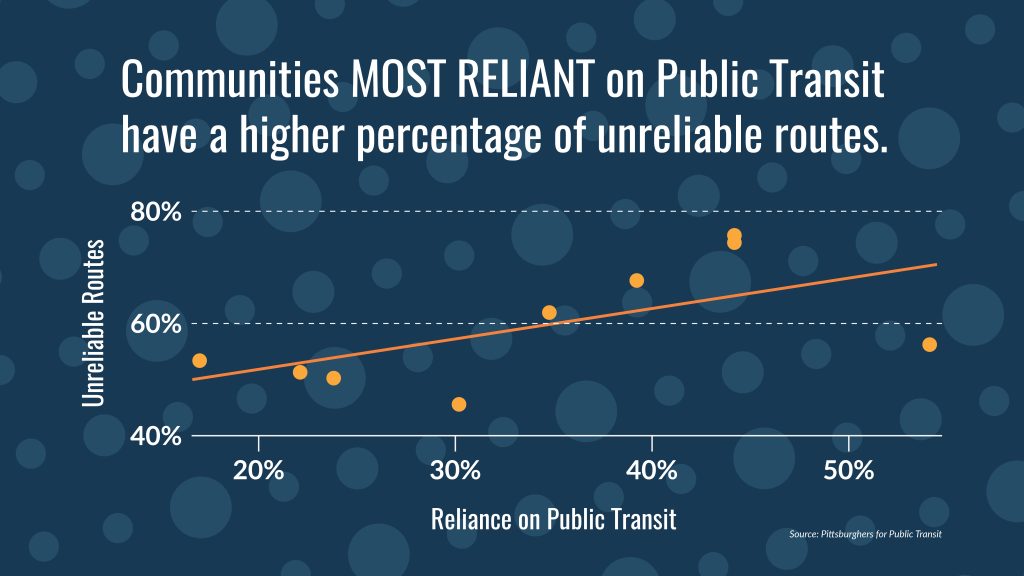
Another study done by PPT in 2018 found that 81% of PRT riders make less than $50,000 annually and 48% identified as people of color.

“Public transit in Allegheny County has always relied on low-income residents and Black riders as its primary constituencies,” according to the “No Greater Need, No Greater Opportunity” study from PPT.
The impacts of unreliable transportation and inadequate affordable housing contribute to the lack of progress on SDG11 and lowers our region’s overall Vibrancy Index score. 

“There needs to be a concerted effort if we are concerned about equitable transportation tied to equitable housing, and equitable housing is having access to the things that people get to enjoy or benefit from,” said Chris Sandvig, executive director of Mobilify Southwestern Pennsylvania.

Collectively, Sandvig said we need to change the way we think about housing and transportation, and move away from car-centered culture to increase vibrancy in our communities.

“Where are the [resources] that the most vulnerable communities need to get to in their lives, and to what degree are we concentrating those in such a way that they are along more resilient transit lines?,” Sandvig said. 

New Sun Rising supports multiple projects through our fiscal sponsorship program and partners with organizations that are uplifting sustainable cities and communities. Contact us to get informed, connected, or help resource the work of Millvale Ecodistrict Collaborative, Triboro Ecodistrict, Hazelwood Initiative, District PGH, and The Partnership Network.

This Power in Numbers data story is part of New Sun Rising’s commitment to using data, technology, organizing, communication, and creativity to help people advocate for the future they envision. Learn more about the Power in Numbers initiative and access the Vibrancy Portal platform. Is there something that you would like to share about health and well-being in your community? Contribute to the conversation through the Community Voice feedback form.

The Vibrancy Index helps people to understand conditions in their community through 50 institutional data points. The VI also generates sub-indices in Culture, Sustainability, Opportunity, and the Sustainable Development Goals (SDG).

Posted in ResourcesTagged Power in Numbers, vibrancy portal

First user guide released to assist in Vibrancy Portal exploration

Posted on September 15, 2023 by Alyse Horn

Information and technology are important tools that can help organizations and communities define and reach their goals, but sometimes aggregating the data can be overwhelming.

To assist nonprofits, social enterprises, and local leaders in gathering data insights through the Vibrancy Portal, New Sun Rising has released an educational video to guide users through the community data Explorer. 

This function can help gain a better understanding of a community’s capital by providing access to actionable data insights and calculating indices. The overall Vibrancy Index is composed of 50 factors for equitable, sustainable communities, with sub-indices in Culture, Sustainability, Opportunity, and the Sustainable Development Goals (SDG).

“The Vibrancy Index shows specific needs in specific places, and if an organization is trying to align themselves with whatever they’re doing, that data is a really good place to start,” said Anthony Harper, co-founder and lead instructor at Beta Builders. 

Democratizing data can help underserved communities be more competitive for resources, and research shows that organizations and collaboratives with high data cultures benefit through increased funding, stronger internal and external relationships, and more effective operations. 

This is the first video in the Vibrancy User Guides series and gives a general overview of how to use Places, Indicators, and Analysis. Future videos will take an individual look at these three topics to provide a deeper understanding of each.

The Vibrancy Portal is part of New Sun Rising’s Power in Numbers initiative that combines data, technology, organizing, communication, and creativity to help people advocate for the future they envision.

Posted in Projects, ResourcesTagged Power in Numbers, vibrancy portal

Vibrancy Index illustrates healthcare disparities among racial, ethnic groups in Southwestern PA

Posted on June 6, 2023 by Alyse Horn

Since 2014, thousands of civil lawsuits have been filed against four U.S. companies that produced prescription opioids, which local and state governments say fueled the ongoing opioid crisis throughout the country for decades. 

A settlement was reached in 2022 for $26 billion and Pennsylvania will receive more than $1 billion, which is intended to fund opioid remediation programs throughout the state. 

According to Spotlight PA, “For several years, Pennsylvania has had one of the country’s highest drug overdose death rates. In 2021, Pennsylvania had 5,350 fatal drug overdoses, and 78% of them involved fentanyl, state data shows.”

Deaths caused by drug and alcohol overdoses, suicide, or liver failure are known as “deaths of despair.” This cause of death in Allegheny County is 22.4% higher than the Pennsylvania average and 45.1% higher than the national average. 

According to data collected through New Sun Rising’s Vibrancy Index, the Black Community makes up 13% of the population in Allegheny County, but suffers 29% of overdose deaths in the area. 

“It starts off as recreational, as a means of escape from the everyday stress of just living life on life’s terms,” said Denise Zellous, director of Zellous Hope Project. “Living with generational poverty and getting up to another day of surviving versus living, it’s easy to get entrapped in something that gives you relief and drugs is something that does.”


Zellous Hope is based in McKees Rocks and provides a bridge over the holes in the road to better living by working with existing organizations to assist with what people say they need.

The high percentage of deaths of despair and the disproportionate effects of overdose deaths in Black Communities contribute to a lack of progress on Sustainable Development Goal 3: Good Health and Well-being and lowers our region’s overall Vibrancy Index score. There are a total of 17 SDG’s, which were created globally as a call to action to raise the quality of life for all people and preserve the future of our planet.

Analysis shows Allegheny County communities that fall within the lowest 20% for Good Health and Well-being (SDG 3) also rank lower for No Poverty (SDG 1), Zero Hunger (SDG 2), and Life on Land (SDG 15). Furthermore, these communities tend to be communities of color, with the non-white population being 2.7x higher in communities with the lowest health index score.

In 2021, 94.6% of county residents had health insurance, which is higher than the state and national average, but that doesn’t always equal adequate support. Zellous said most of the safety nets that are accessible for those who need help have holes where people can slip through, or don’t cover the basic needs necessary to stabilize an individual. And it is not only the affected residents who are impacted by these statistics.

Community leaders working with those who suffer from generational trauma or addiction can become burnt out physically and emotionally. This kind of exhaustion only became exasperated by the COVID-19 pandemic, and recognizing the lack of support for leaders in the area, the Nonprofit Resilience Program was developed through conversations between New Sun Rising, Neighborhood Allies, B.O.S.S Consulting, and other members of The Partnership Network who were concerned about the retention of nonprofit leaders.

“You talk about professional boundaries, but you’re human,” Zellous said. “It really takes a toll on you, because you can’t help but be emotionally moved by the fact that for every person you help, there are four to five more that you can’t reach.”

“And not only are you fighting to make a difference, but you’ve got policies in place that make it almost impossible to do that, because you’re fighting against laws that are outdated and counterintuitive to what it is that you’re trying to do.”

To learn more about how funds from the opioid lawsuit settlements will be distributed and to voice your opinions in the decision making, click here.  

New Sun Rising supports multiple projects and organizations through our fiscal sponsorship program that are elevating the health and well-being of Allegheny County, including: Pittsburgh Bridges OCD, Unshakeable Motherhood, Melanin Mommies, Flourish Ed, Birth Your Way, Visible Hands, and Grow Sto-Rox. 

This Power in Numbers data story is part of New Sun Rising’s commitment to using data, technology, organizing, communication, and creativity to help people advocate for the future they envision. Learn more about the Power in Numbers initiative and access the Vibrancy Portal platform. Is there something that you would like to share about health and well-being in your community? Contribute to the conversation through the Community Voice feedback form.

The Vibrancy Index helps people to understand conditions in their community through 50 institutional data points.  The VI also generates sub-indices in Culture, Sustainability, Opportunity, and the Sustainable Development Goals (SDG).  The Good Health and Well-being (SDG 3) Index includes five different indicators such as rates of cancer, cardiovascular disease, diabetes, substance abuse and addiction, and air quality. 

Posted in FeaturedTagged Power in Numbers, sustainable development goals, vibrancy index, vibrancy portal

Vibrancy Index data illuminates inequitable distribution of school funding

Posted on March 13, 2023 by Alyse Horn

A recent ruling by a Commonwealth Court judge determined that Pennsylvania’s school funding system is unconstitutional, given how heavily it relies on a district’s property taxes.


The result has been fewer resources for students living in low income districts, further perpetuating inequity within the state by failing to meet Sustainable Development Goal 4 Quality Education (SDG 4). There are a total of 17 SDG’s, which were created by the United Nations as a call to action to raise the quality of life for all people on the planet. 

“Students in poorer districts have not had access. Their schools don’t offer the same enrichment programs or have the same academic expectations as those in wealthier communities. That’s the way it has been for a very long time,” said Bridget Clement, Executive Director for Communities in Schools Pittsburgh-Allegheny County. “This ruling is a great step forward. Now it’s time for the hard work – figuring out where the additional funding will come from.”

Using data collected through New Sun Rising’s Vibrancy Index, Allegheny and Beaver County communities that fall within the lowest 20% for Quality Education (SDG 4) also rank lower for No Poverty (SDG 1), Zero Hunger (SDG 2), and Decent Work & Economic Growth (SDG 8). Furthermore, these communities tend to be communities of color, with the non-white population being three times higher compared to communities that rank in the highest 20% for Quality Education (SDG 4).

In the nearly 800 page document, Judge Renée Cohn Jubelire determined that Pennsylvania has failed to comply with the constitution by discriminating against poorer districts, disproportionately impacting children of color and children from low income families. 

“Fixing the school funding is critically important but it’s only one part of the solution, we’ve got to work on the community as a whole,” Clement said. 

The impacts of the current school funding model, illuminated by the Vibrancy Index data, shows how the inequitable distribution of funds limits opportunities for students to thrive and is connected to other outcomes within a community. Judge Jubelire ruling concludes that regardless of class or ethnicity, education is a fundamental right and Pennsylvania must provide students with a “meaningful opportunity to succeed academically, socially, and civically.” 


This Power in Numbers data story is part of New Sun Rising’s commitment to using data, technology, organizing, communication, and creativity to help people advocate for the future they envision. Learn more about the Power in Numbers initiative and access the Vibrancy Portal platform. Is there something that you would like to share about your experience with education system funding and outcomes? Contribute to the conversation through the community voice feedback form.

The Vibrancy Index helps people to understand conditions in their community through 50 institutional data points.  The VI also generates sub-indices in Culture, Sustainability, Opportunity, and the Sustainable Development Goals (SDG).  Quality Education (SDG 4) includes seven different indicators such as preschool attendance, high school completion, and certification, Associates, Bachelors, and Graduate degrees. It is part of the Opportunity Index along with Poverty, Workforce, and Industry & Innovation.

Posted in General InformationTagged Power in Numbers, vibrancy index, vibrancy portal

Data + Creative Advocacy initiative launches to promote impact, social innovation

Posted on July 6, 2022 by Alyse Horn

Graphic by Hunter Smith

To support the data needs of under-resourced organizations and communities, New Sun Rising (NSR) launched the Power in Numbers (PiN) initiative in 2019.

At 1 p.m. on Wednesday, June 29, Power in Numbers 2.0 kicked off with a virtual event to introduce two new resources, the Vibrancy Portal 2.0 data platform and the Creative Advocacy Playbook. The event, led by NSR Executive Director Scott Wolovich, had participants from the United Kingdom, California, and New York, among other locations. 

The Vibrancy Portal is a tool for nonprofit, social enterprise, and municipal leaders that aims to make data more actionable through greater access, insights, and integration. The new updates include a redesign of the user interface, more dynamic database structure, enhanced and expanded data sets, organizational ecosystem mapping, and the addition of Beaver County to the map.

“We know that for social innovation to grow, there needs to be investment in data and communications, and the ability to more effectively engage with the world around us,” Wolovich said. “Unfortunately, most small and community-led organizations lack this critical capacity.”

“Our own research showed that 80 percent of leaders placed high value on these things, but only 17 percent of them reported receiving related funding. This lack of investment really restricts their ability to compete for resources and grow their impact.”

The Portal serves to democratize data through two primary functions: a community data Explorer and organizational data Manager.

For the free and publicly available Explore website, NSR built upon work started with Carnegie Mellon University and participants in their own fellowship program to create a geo mapping application that is organized by the Sustainable Development Goals (SDG). Although similar tools exist, most provide information at the county level and are not sensitive enough to show differing conditions between neighborhoods.

The Manager section of the website allows leaders to collect, analyze, and communicate data around 5 key areas: Issues, Capacity, Impact, Finances, and Reports. The site is password protected allowing teams to collaborate and encourage an actionable data model.

Lydia Moran of CONNECT, said they have been working with dozens of organizations over the last two years to create a multi-municipal climate action plan. During the Power in Numbers session, Moran also shared progress from the regional DISCOVER network. With so many different organizations involved across these efforts, a database like the Vibrancy Portal could make it easier to collect data and communicate regional impact.

“It’s really hard for us to talk about regional impact if we’re all measuring different things, and we’re not speaking the same language.” Moran said. “I’m very excited about this platform.”

The idea for the Creative Advocacy Playbook, which is being co-created with RiverWise, came from wanting to shift the paradigms and mindsets that hold existing systems in place and combat divisiveness while increasing engagement and awareness. The playbook will be publicly available and begin to support the launch of campaigns later this summer. While Wolovich admits there have been artists producing creative advocacy for years, “what makes this initiative unique is that it’s focused on building creative capital as an asset starting with the nonprofit and community itself.”

As far as the Vibrancy Portal goes, it is free, public, and ready to be explored. 

“It’s a dynamic ongoing project, and we’ll continue to build it out as we’re able to attract more resources,” Wolovich said. “We do have gaps in the data that we know are important for communities that we are working with, and welcome the help to identify or even think about different ways to approach those gaps.”

Although the initiative is in its early stages, one thing that has been made clear is that institutionally collected data largely shapes the narrative around communities. Power in Numbers helps under-resourced leaders work beyond the limitations of traditional data to more fully reflect, resource, and inspire the life of their community. 

Do you know an organization, issue, or community that would benefit from greater data utilization and creative advocacy? Email info@newsunrising.org to get involved.

Posted in Events, ProgramsTagged Power in Numbers, vibrancy index, vibrancy portal, Vibrant Communities

Initiative launches to strengthen data culture, promote more effective collaboration between organizations, community

Posted on January 29, 2021 by Alyse Horn

Above: Community leaders gather for the EcoDistricts Incubator at the Millvale Food + Energy Hub in 2019.

There are handfuls of reasons as to why individuals choose careers in the nonprofit sector, but at the basis of them all is the desire to help others.

Whatever sector that may be, to make the greatest impact in the lives of the people they work with, a nonprofit is constantly learning information about the needs of the community and using it to secure resources that improve their conditions.

Essentially, data collection turns a person into a number. But if a nonprofit has the tools to take that data, flip it, and reverse it, they can successfully turn that number back into a person.

To increase transparency between organizations and communities, and help them access the information and technology needed to reach their shared goals, New Sun Rising launched the Power in Numbers initiative.

This initiative allows leaders to track and compare their progress towards achieving the Sustainable Development Goals through a central technology data management system: the Vibrancy Portal.

“I see this as a way of really bringing the community in to understanding the importance of numbers and why organizations may ask them specific questions,” said Jamie Johnson, Director of Programs at New Sun Rising. “Then there is the opportunity to have that anecdotal and qualitative storytelling happening so it personifies those numbers and connects the community at the same time.”

By assisting organizations in collecting and managing their information, this initiative gives leaders the ability to generate insights across multiple data sets to improve their outcomes, produce better reports, and engage stakeholders through storytelling.  The information also contributes to a shared data resource, which serves to promote collective impact and advocacy.

Brown Mamas Executive Director Muffy Mendoza said utilizing this initiative has been monumental for her small organization.

“Power in Numbers allows me to do the capacity building work that I need to do without hiring an employee or spending funds that my organization doesn’t have,” Mendoza said. “This year, I was able to do some foundational work that I’d been putting off for years through the Power in Numbers initiative. It helped me apply for more funding and develop a strategic plan to guide Brown Mamas in the next 2-5 years.”

Johnson said that a strengthened data culture can allow nonprofit and social enterprise leaders to see the areas where they excel and where they can improve, and then share that information back to the people they serve to ask what can be done differently as well as celebrate the areas where they are doing well.

“My biggest thing is getting away from people being boiled down to a number, but knowing that number represents a life in a community and how do we bring life back to these numbers? I think this is a way we can do that, but it’s going to take community understanding and buy in for that to really happen,” said Johnson.

The Power in Numbers initiative builds upon years of investment by New Sun Rising designed to strengthen the region’s capacity for data collection, collective impact, and the Sustainable Development Goals.  At launch, the initiative will serve nonprofits and social enterprises that have participated in New Sun Rising’s capacity building or intermediary funding programs. 

To learn more about how to bring the power of data and collective impact to your work, register for the upcoming Power in Numbers Workshop on Tuesday, February 23 from 12-1 p.m. Partnership or media inquiries about the initiative can be emailed to info@newsunrising.org. 

Power in Numbers was developed and launched through the grant support of The Pittsburgh Foundation and Google (Tides Foundation). 

Posted in Programs, ResourcesTagged New Sun Rising, Power in Numbers, vibrancy index, vibrancy portal

Categories

  • Events
  • Featured
  • General Information
  • Programs
  • Projects
  • Resources

Archives

Tags

  • culture
  • opportunity
  • sustainability
  • Vibrant Communities
  • Triboro ecodistrict
  • New Sun Rising
  • millvale Ecodistrict
  • One Northside
  • Sharpsburg ecodistrict
  • Vibrancy Funds
  • Etna ecodistrict
  • Ignite Northside
  • equity
  • Power in Numbers
  • vibrancy index
  • covid-19
  • Nonprofit Resilience Program
  • millvale
  • vibrancy portal
  • sustainable development goals
  • EcoDistricts
  • Homewood
  • RiverWise
  • environmental justice
  • Positive Deviants
  • Justice 40 Opportunity Navigator
  • Etna
  • neighborhood allies
  • ignite
  • the partnership network
  • Wilkinsburg
  • grow Sto-Rox
  • Arts Equity Reimagined
  • #Grow
  • Launch Wilkinsburg
  • Impact
  • fiscal sponsorship
  • The Hear Foundation
  • District PGH
  • Ignite Workshops
  • Launch Sto-Rox
  • Collective Action for Re-Imagining
  • mckees rocks
  • launch sustainability
  • Ignite Vibrancy: Collective Impact
  • Larimer
  • The Staunton Farm Foundation
  • Sharpsburg
  • vibrancy awards
  • millvale ecodisrict

Keep up with New Sun Rising

New Sun Rising PO Box 58005
Pittsburgh, PA 15209
 USA

Email:

info@newsunrising.org

New Sun Rising is a GuideStar
Gold Participant

Connect with Us

© 2026 New Sun Rising. All rights reserved.

Website by Imagebox