
Active Economy Report shows investment in community projects produces $845 million in economic impact
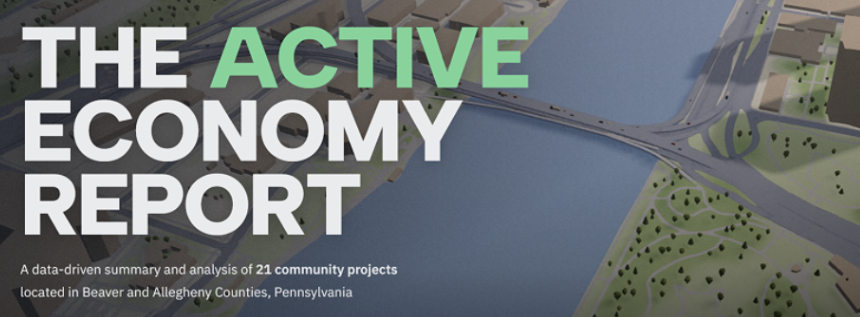
A University of Pittsburgh study illustrates how diversified development contributes to Southwestern PA’s growth and resilience.
WESTERN Pa. — What does a children’s museum, a workforce training campus, and a food co-op have in common? Hundreds of millions in regional economic benefit over the next decade.
The Active Economy Report, a new study of 21 community projects across Beaver and Allegheny Counties, found that together they will produce $845 million of Gross Regional Product (GRP) and 6,640 job years. This is on par with what large-scale corporate projects promise, but the work is already here, more likely to stay here, and benefits accrue to the communities who initiate and sustain the work.
Commissioned by RiverWise & New Sun Rising (NSR) and completed by the University Center for Urban and Social Research (UCSUR) at the University of Pittsburgh, the research shows that economic growth is amplified by an additional $123 million in Social Return on Investment (SROI) over 20 years. These social benefits strengthen regional resilience through vacant building renovation, food and energy improvements, small business and workforce development, public health and safety, mobility infrastructure, and the creative economy.
“Thoughtful community development efforts can be a significant driver of local economies,” said Daniel Rossi-Keen, Executive Director of RiverWise, and a co-author of the Active Economy Report. “For nearly a decade, the leaders we work with have intuitively known that to be true, but we’ve had limited data to demonstrate this to others. Thanks to the work of UCSUR, we are now able to quantify the economic impact of 21 projects underway throughout Southwestern Pennsylvania that have been quietly growing a healthier economy for the region. That impact is overwhelmingly significant and has wide-reaching implications for how the region undertakes planning, deploys our resources, and builds our economic future.”
The Active Economy Report and website are built on three key insights that the data make clear, and which the report addresses in detail:
- Community projects generate local economic value on par with large-scale corporate projects, yet with less public subsidy and risk.
- Diversified project clusters reduce regional dependence on any single industry and are less susceptible to boom and bust cycles.
- Community projects generate substantial social value beyond their economic impact.
“Too often, decision-makers are asked to choose between development that is either good for the regional economy or good for people in local communities,” said Scott Wolovich, Executive Director at NSR and co-author of the report. “What excites us about the Active Economy Report is that we now have evidence of a third option: we can actually do both.”
Relying heavily on independent research conducted by leading economist Christopher Briem and the team at the UCSUR, this research quantifies the past and future impact of stimulating the Active Economy using two accepted analytical frameworks: traditional economic impact analysis and social return on investment (SROI).
“For communities that have experienced several decades of slow population growth,” said Briem, Regional Economist at UCSUR, “questions of quality of life and community capacity are not peripheral to economic development — they are increasingly central to it.”
The Active Economy Report highlights an established model for creating regional conditions that attract and retain talent, sustain and enhance quality of life, and produce the kind of resilience amenable to long-term economic prosperity.
The research behind the Active Economy Report was made possible through a grant from the Just Transition Fund (JTF) as part of their inaugural Coal Communities Get Ready! Challenge. The Get Ready! Challenge was designed by the JTF to fund early-stage visionary projects with the potential to generate significant economic impact and produce measurable outcomes in the long-term.
“These are exactly the kind of local economic projects the Just Transition Fund’s investments help accelerate. A region that diversifies beyond a single dominant industry builds real insulation against boom-and-bust cycles that rural energy communities know all too well. The Active Economy Report shows how diversification can happen, project by project, across Southwestern Pennsylvania,” said Heidi Binko, Co-Founder and Chief Executive Officer of the JTF.
The full Active Economy Report, along with an accompanying website, will be released publicly on September 8, 2026. To learn more about the Active Economy Report, visit ActiveEconomy.org.
About RiverWise: RiverWise organizes community voice and power so that residents can reclaim agency over the future of communities along the rivers of Beaver County, Pa.
About New Sun Rising: NSR supports local leaders with the skills, funding, connections, and data to build vibrant communities throughout Greater Pittsburgh.
About University Center for Urban and Social Research at the University of Pittsburgh: UCSUR serves as a resource for communities, researchers, and educators interested in using community engaged research for problem-solving.
About Just Transition Fund: JTF is the only philanthropic initiative solely focused on coal community transition. They support local innovators and community advocates building diverse and resilient economies.