ImageboxSite LogoLeft ArrowPrevious ItemNext ItemRight ArrowBlog PostEventGrowIgniteLaunchLocationXMenuQuoteSearchGoogle PlusYoutube
New Sun Rising
Menu
Close
  • How We Work
    • Overview
    • Impact Areas
    • Development Phases
  • Capacity Building
    • Nonprofit Resilience Program
    • Sustainable Futures Initiative
    • Learning Resources
  • Accessible Funding
    • Fiscal Sponsorship
    • 250 Tables
    • Community Grantmaking
  • Data + Advocacy
    • Vibrancy Portal
    • Virtual Support Center
    • Community Voice
    • Creative Advocacy
  • Spaces
    • Food + Energy Hub
    • Solar Garden Patio
  • Home
  • Blog
  • Projects We Support
  • About Us
    • Team
    • We Stand Against Racism + Discrimination
    • We Hear You
    • History
    • Jobs + Opportunities
  • Contact
  • Make a Donation
New Sun Rising
  • Home
  • Blog
  • Projects We Support
  • About Us
    • Team
    • We Stand Against Racism + Discrimination
    • We Hear You
    • History
    • Jobs + Opportunities
  • Contact
  • Search
  • Make a Donation
  • How We Work
    • Overview
    • Impact Areas
    • Development Phases
  • Capacity Building
    • Nonprofit Resilience Program
    • Sustainable Futures Initiative
    • Learning Resources
  • Accessible Funding
    • Fiscal Sponsorship
    • 250 Tables
    • Community Grantmaking
  • Data + Advocacy
    • Vibrancy Portal
    • Virtual Support Center
    • Community Voice
    • Creative Advocacy
  • Spaces
    • Food + Energy Hub
    • Solar Garden Patio
The Blog of NSR

Tag: Justice 40 Opportunity Navigator

Nonprofits ‘launch’ incubator program for local environmental-focused community projects
Posted on August 12, 2024 by Alyse Horn

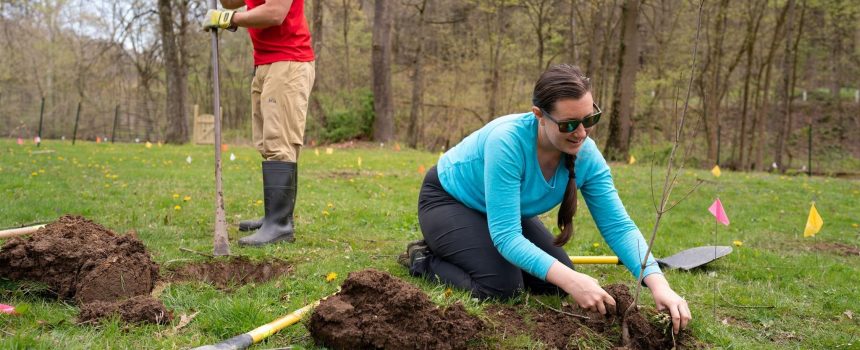
Above: A Reforest Our Future tree planting at Brady’s Run Park. Photo by Rustbelt Mayberry Photography. 

New Sun Rising and RiverWise select 12 local projects for ‘Launch EJ Incubator’ cohort to support community, environment, and equity


SOUTHWESTERN, PA — Communities are rich with individuals who have ideas that can transform their environment, but there is a need for more spaces that support these community visionaries to cultivate their ideas into reality. 

That’s where the Launch Environmental Justice (EJ) Incubator comes in.   

Together, New Sun Rising and RiverWise sought out community projects across Allegheny and Beaver Counties that prioritize equity, energy, mobility, water, food, and air quality. Through this process, 12 projects were selected to join the Launch EJ Incubator, which will kick-off the six-month cohort on Thursday, August 22. 

“Launch EJ utilizes time-tested development phases created by New Sun RIsing’s Vibrant Communities Framework, which helps project leaders Ignite, Launch, and Grow their impact. The goal of this new initiative, in collaboration with RiverWise, is to use the existing model and apply an environmental justice lens,” said Tyler Schaub, Environmental Justice Project Manager for New Sun Rising and RiverWise.

The cohort will meet monthly and include workshops, educational speakers, and one-on-one technical assistance. The projects include: 

  • Wendy Whelpley, Beaver Falls Bike Trail Connector
  • Marcus Shoffner, Outdoor Inclusion Coalition
  • Tim Iman, Beaver County Regional Food Hub
  • Aquene Watkins-Wise, Healing House
  • Terri Minor Spencer, West End P.O.W.E.R.
  • Ginger Brooks Takahashi, General Sisters
  • Jeff Karwoski, Reforest Our Future
  • Annie Quinn, The Mon Water Project
  • Mary Alice Gettings, Aliquippa Food Co-op
  • Fitzhugh Shaw, NEBRS Land Trust
  • Ebony Lunsford Evans, Out of the End Incorporated
  • Raynise Kelly, Soil Sisters Plant Nursery

“Accessibility matters because it breathes life into the promise of belonging. It tears down walls, allowing every soul to contribute their light, weaving a tapestry where every thread is seen and valued. When barriers fall, a more profound, inclusive world emerges, where every spirit can rise and flourish,” said Tacumba Turner, Environmental Justice Community Coordinator for RiverWise and New Sun Rising.

The Incubator program supports the development, fundraising, and implementation of projects that exist within a federally-designated environmental justice census tract in Allegheny and Beaver Counties. These “EJ” areas are neighborhoods that have experienced historic disinvestment and have been impacted by past and present environmental harm. For a map of EJ census tracts and underlying conditions, visit the Vibrancy Portal.

To help fight against generational marginalization experienced by these communities, the Biden-Harris Administration created the Justice 40 initiative, which commits 40% of the benefits of nearly $2 trillion of certain federal investments — such as the Inflation Reduction Act (IRA) and Bipartisan Infrastructure Law (BIL) — to flow into these “EJ” communities. 

In response, New Sun Rising and RiverWise co-created the Justice 40 Opportunity Navigator, which houses the Launch EJ Incubator, to increase the accessibility of these historic funds. This incubator builds upon the Ignite EJ Workshops held this past May.

New Sun Rising ​​collaborates with communities to build capacity, access funding, and embrace data-informed approaches towards their own vibrant future. For more information, visit https://www.newsunrising.org/. 

RiverWise organizes community power and voice so that residents of Beaver County can exercise greater agency over the future of their communities. For more information, visit https://www.getriverwise.com/. 
Posted in ProgramsTagged environmental justice, Justice 40 Opportunity Navigator

Community leaders supported to combat environmental injustice, improving health and climate resilience

Posted on August 1, 2024 by Alyse Horn

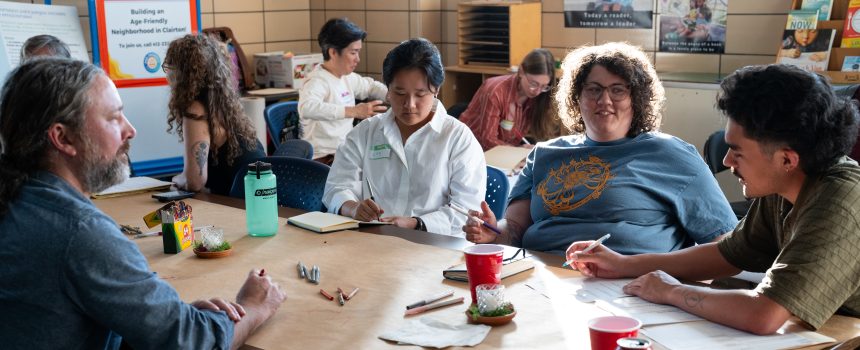
Above: Participants from the Ignite Environmental Justice Workshop – Monongahela Valley at Clairton Family Center on May 30. Photo by Rustbelt Mayberry Photography.

Aimed to educate and support community project leaders, the Ignite Environmental Justice Workshops concluded in May with over 30 participants attending the three workshops.

Strategically located in the Allegheny, Ohio, and Monongahela River Valleys, New Sun Rising and RiverWise hosted these events to help Environmental Justice (EJ) projects become better informed on how to develop and communicate their plans, and prepare to access federal Justice 40 grants. 

“I think the more education, the more people, the more language we put [into] it, the more tangible it starts to become,” said Amber Thompson, Ignite EJ – Allegheny Valley participant.

Environmental Justice communities are places that have experienced generational disinvestment – often alongside the consequences of polluting and extracting industries. The Justice 40 initiative is a historic commitment by the Federal government stating that 40 percent of the overall benefits of almost $2 trillion in certain federal investments, such as the Inflation Reduction Act (IRA) and Bipartisan Infrastructure Law (BIL), flow into these communities. Improving climate resilience and health through projects that address energy, water, air, mobility, food, and economic opportunity are core to the initiative. 

Marginalized by underinvestment and overburdened by pollution, the federally designated EJ areas in Greater Pittsburgh have experienced the consequences of environmental injustice affecting nearly every aspect of their quality of life.

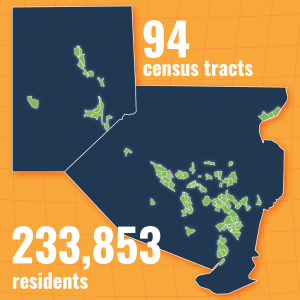
In Allegheny and Beaver Counties, there are 94 EJ census tracts that represent 233,852 residents and 16.8% of the total population. These residents, including a higher percentage of minority, racial and ethnic groups such as Black or African American, Asian, Hispanic or Latino, and Native American, face disproportionate economic and environmental challenges solely due to their location. Although minority groups represent 18% of the overall population in Allegheny and Beaver Counties, they make up 38% of the population residing in EJ communities. 

How are people living in EJ communities affected by their surroundings compared to Allegheny and Beaver Counties? 


Residents are less likely to own homes, but housing is more affordable.

Percentage of homeownership rates
—EJ Communities: 46.7%
—Allegheny & Beaver Counties: 63.8%

Percentage of housing affordability
—EJ Communities: 41.4%
—Allegheny & Beaver Counties: 34.7%


Public transportation is more accessible.

Percentage of access to public transit
—EJ Communities: 20%
—Allegheny & Beaver Counties: 11.7%


Adults are less likely to complete high school.

Percentage of adults who did not complete high school or the equivalency
—EJ Communities: 23.7%
—Allegheny & Beaver Counties: 17%


Adolescent birth rates are higher.

Percentage of adolescent girls between 15-19 years old who have given birth
—EJ Communities: 16%
—Allegheny & Beaver Counties: 4.9%


More women live below the poverty line, but the median earnings gap between men and women is smaller.

Percentage of women living below the poverty line
—EJ Communities: 27%
—Allegheny & Beaver Counties: 14%

Median earnings gap between men and women
—EJ Communities: -$5,722
—Allegheny & Beaver Counties: -$14,067

Source: Vibrancy Portal

The sources and history of environmental injustice in our region, possibly more than any in the nation, are deeply rooted in the United States’ industrial past. Through fossil fuel extraction and carbon-intensive practices, particularly in coal mining and steel production, the Greater Pittsburgh region became a world-renowned industrial hub. The result: extreme levels of air and water pollution. 

While strides have been made to improve the environment, the region still faces air quality challenges. In Beaver County, the ongoing industrial activities of the Shell Polymers Monaca plant continue to contribute to air and water pollution. The Shell plant, which opened in the fall of 2022, has faced 13 notices of violations and at least 26 malfunctions within a year. 

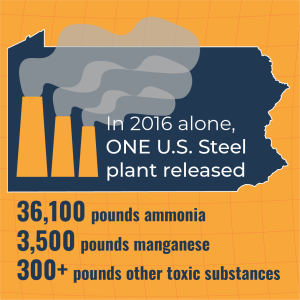
In Allegheny County, U.S. Steel’s Edgar Thomson Works has a decades-long history of clean air violations. Based on Toxic Release Inventory data, air pollution from the plant included 36,100 pounds of ammonia, 3,500 pounds of manganese, and more than 300 pounds of other toxic substances in 2016 alone. The ongoing contamination has led to various health problems for residents, including respiratory issues and increased cancer risks. 

General Sisters, a community and artist collective in North Braddock, can see the Edgar Thomson Plant from their building. Ginger Brooks Takahashi of General Sisters said in 2015, the threat of hydraulic fracturing came to their neighborhood and alongside community members they “fought and resisted the placement of well pads” in the land above their building.

“Through this fight, we learned more about the existing air quality in our neighborhood. This led us to work with Create Lab to host the Breathe Cam on our roof that monitors emissions of Edgar Thomson Works,” Takashi said. “The Breathe Cam provides 24-hour video monitoring of air pollution from multiple industrial sources in the Monongahela Valley and the larger region.” 

On May 30 at the Clairton Family Center, Takashi participated in the Ignite EJ Workshop and optional pitch competition where she won first place for her project General Sisters Environmental Study Center. The larger goal for the building is “to provide a space where we can gather with our neighbors and continue work… to advocate for our health in relationship to the legacy polluter in our neighborhood.”

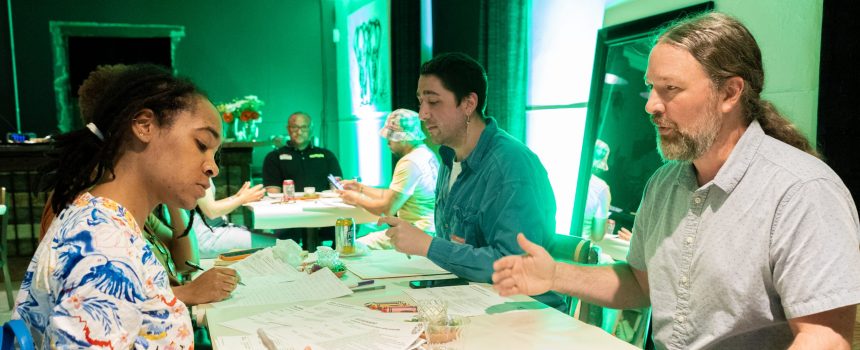
The pitch winners for the Allegheny and Ohio Valley workshops, Ebony Evans of Out of the End Incorporated, and David Slebodnik and Tami Gilbert of Aliquippa Food Cooperative, focused on increased food access in their communities. 
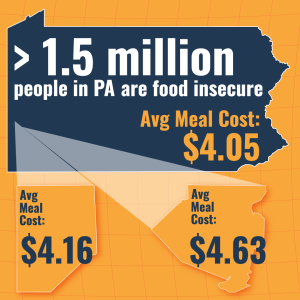
In Allegheny County, 11.4% of residents face food insecurity, with the cost of a meal at $4.63, which is 14% above the state average and 16% above the national average. In Beaver County, 12.3% of residents are food insecure, with meal costs at $4.16, which is 2.7% higher than the state average and 4.3% higher than the national average.

Though EJ communities face heightened challenges compared to others within Allegheny and Beaver Counties, a detailed analysis of responses from Ignite workshop participants found that residents of Allegheny, Ohio, and Monongahela Valleys emphasized the strength, resilience, and supportive nature of their residents. 

“Environmental justice is about recognizing the sacredness and living quality of the land that we live on and there are obstacles to that reciprocity and sacredness. Those obstacles are injustices and our work is the work of repair, restoration and healing,” said Fitzhugh Shaw of Greater Valley Community Services and Ignite EJ – Monongahela Valley participant.

On August 1, the Launch EJ Incubator cohort began to support the development, funding, and implementation of 12 projects working within a federally designated EJ census tract in Allegheny or Beaver Counties. The program blends monthly cohort workshops, educational speakers, and individual one-on-one technical assistance including grant advisors, creating a robust environment to support EJ projects. This is the second stage of development within New Sun Rising’s Ignite, Launch, Grow framework. 

To learn more about environmental justice and to see if you live in an EJ community, visit the Vibrancy Portal and select “Show Federal Environmental Justice Tracts” below the map. Are you working on a community project that falls within these designated areas? Get support through the Justice 40 Opportunity Navigator (J40N) by filling out this intake form. Additional EJ education is available through our J40N training videos.

The EJ Workshops, Incubator, and J40N is an initiative of New Sun Rising and RiverWise, in partnership with regional networks and community-based organizations.


Posted in Programs, ResourcesTagged environmental justice, Justice 40 Opportunity Navigator

Regional leaders, residents receive support to access environmental justice funding

Posted on May 15, 2024 by Alyse Horn

Above: Workshop participants Jazmyn Rudolph (left) and NSR Executive Director Scott Wolovich (right) talk through Rudolph’s project and prepare for the pitch competition at the Ignite Environmental Justice Workshop at the Millvale Food + Energy Hub on May 2.

The Millvale Food + Energy Hub was a conduit for Allegheny County residents and local leaders seeking support for their community projects on May 2, preparing them to access federal funding through the Justice 40 Initiative. 

The Ignite Environmental Justice Workshop – Allegheny Valley, the first of three, brought together organizers from 12 projects who shared the same goal: improve the health, climate resilience, and economic opportunity of our region. The workshop series was co-developed by nonprofits New Sun Rising and RiverWise to better inform residents about environmental justice and how it relates to their community projects, while receiving support to establish and communicate their plan.

“We can get overwhelmed thinking about applying for major grants and the more formal procedures that make ideas into tangible projects. Being able to create a space where there is no judgment, open lines of communication, and honest feedback is so important in project development because [these projects] affect people’s lives so intimately,” said Eric Macadangdang, director of collaboration & connectivity of SWPA Municipal Project Hub and workshop mentor.

Environmental justice (EJ) communities are places that have experienced generational disinvestment — often alongside the consequences of polluting and extracting industries. The government’s historic commitment states that 40 percent of the overall benefits of almost $2 trillion in certain federal investments, such as the Inflation Reduction Act (IRA) and Bipartisan Infrastructure Law (BIL), flow to disadvantaged EJ communities. 

https://www.newsunrising.org/wp-content/uploads/2024/05/EJ_Millvale_Video_Final01.mp4


Tyler Schaub, environmental justice project manager for New Sun Rising, said it was encouraging to see the diversity of projects attending the workshop, and the commitment from leaders to execute their plans was “inspiring and impactful.”

Projects were in various stages of preparation, from concept or idea to early implementation, and ranged from training and workforce development for doulas, to the sustainable restoration of our rivers and increasing access to healthy and fresh foods.

Workshop participant Lisa Freeman, founder of Freeman Family Farm, spoke to the RiverWise Storytelling Team during the event and said in the past, marginalized communities haven’t been at the table to receive this kind of funding. 

“I knew of Justice 40, but I did not know how it was going to be implemented,” Freeman said. “We often wait for the trickle down effect, that eventually it will come to us, and now with this opportunity we don’t have to wait… we need to be at the table and engaging our residents and striking up that conversation.”

At the end of the workshop, project leaders were given the opportunity to participate in a pitch competition with the top three winners slated to receive support from the SWPA Municipal Project Hub and first place was given a guaranteed spot in the upcoming Launch Environmental Justice Incubator program. The pitch winners included: Ebony Evans of Farmer Girl Eb, Jazmyn Rudolph for agricultural-based education opportunities, and Annie Quinn of The Mon Water Project.

“Get it on paper and make this thing come alive,” said Tacumba Turner, environmental justice community coordinator at RiverWise. “Docketing, creating sophisticated processes, that won’t happen in one fell swoop, but these workshops can provide a solid foundation to build on. Regardless of doing the pitch, if this is a project you want to pursue, it will be a good touchstone to see where you’re at.”

There are two more workshops scheduled for this month: Wednesday, May 22 at Whitted Media Content House in Beaver Falls and Thursday, May 30, location TBD in Monongahela Valley. Both workshops run from 5-9 p.m. The deadline to apply for the May 22 workshop is Monday, May 20 at 8 p.m. The deadline to apply for the May 30 workshop is Tuesday, May 28 at 8 p.m.

Those interested in attending a workshop should apply via the Community Project Intake Form. Those interested in becoming a project mentor are encouraged to email tyler@newsunrising.org.

The Ignite Environmental Justice Workshops are part of the newly launched Justice 40 Opportunity Navigator, a joint initiative between New Sun Rising and RiverWise. 

Posted in Events, General Information, ProgramsTagged environmental justice, Justice 40 Opportunity Navigator

Categories

  • Events
  • Featured
  • General Information
  • Programs
  • Projects
  • Resources

Archives

Tags

  • culture
  • opportunity
  • sustainability
  • Vibrant Communities
  • Triboro ecodistrict
  • New Sun Rising
  • millvale Ecodistrict
  • One Northside
  • Sharpsburg ecodistrict
  • Vibrancy Funds
  • Etna ecodistrict
  • Ignite Northside
  • equity
  • Power in Numbers
  • vibrancy index
  • covid-19
  • Nonprofit Resilience Program
  • millvale
  • vibrancy portal
  • sustainable development goals
  • EcoDistricts
  • Homewood
  • RiverWise
  • environmental justice
  • Positive Deviants
  • Justice 40 Opportunity Navigator
  • Etna
  • neighborhood allies
  • ignite
  • the partnership network
  • Wilkinsburg
  • grow Sto-Rox
  • Arts Equity Reimagined
  • #Grow
  • Launch Wilkinsburg
  • Impact
  • fiscal sponsorship
  • The Hear Foundation
  • District PGH
  • Ignite Workshops
  • Launch Sto-Rox
  • Collective Action for Re-Imagining
  • mckees rocks
  • launch sustainability
  • Ignite Vibrancy: Collective Impact
  • Larimer
  • The Staunton Farm Foundation
  • Sharpsburg
  • vibrancy awards
  • millvale ecodisrict

Keep up with New Sun Rising

New Sun Rising PO Box 58005
Pittsburgh, PA 15209
 USA

Email:

info@newsunrising.org

New Sun Rising is a GuideStar
Gold Participant

Connect with Us

© 2026 New Sun Rising. All rights reserved.

Website by Imagebox